International Studies Journal (ISJ)

International Studies Journal (ISJ)

Summary of statistics and quarterly information

Standard Summary Journal Name: ISJ

Rank in the publications of the Ministry of Science (2022): A

ISC Rank 2024: Q2

ISC IF 2023: 0.358

Article Views 1,572,247 

The number of downloads of the original article is 507,510 

Number of articles submitted 1,463 

Number of rejected articles 982 

Number of accepted articles 309 

Number of days for the first action: 3

Number of days to accept the article 150 

Acceptance percentage 21 

Observation ratio per article 1997.77

File download ratio per article 644.87

Number of indexed databases 14

Country of printing: Iran

Print status: paper (limited) and electronic

Printing editions: Quarterly

Journal language: Persian-English

Article Receipt Form: Only through the system

Article printing cost: Yes

Free access to articles: Yes

Using the similarity system: Yes (Samim Nour) 

 QR_isjq 


The international studies journal (quarterly periodical) is a scientific journal which started its activities based on a regulation No. 25685/11 issued by ministry of research, science and technology on April 29, 2019.

For the kind attention of respected authors, Please consider this point that publishing articles in ISJ involves expenses.

For obtaining more information regarding the related costs, you can refer to the articles acceptance process in the journal information menu. For getting information regarding the arrangement of articles, you can refer to the guidance for authors. 
ISJ is a Gold Open Access Journal

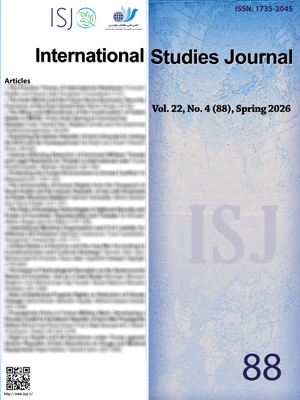
Current Issue: Volume 22, Issue 3 - Serial Number 87, Winter 2026 

Keywords Cloud

  • Human rights
  • Iran
  • international relations
  • Foreign Policy
  • Middle East
  • International Law
  • Security
  • China
  • US
  • Transitional Justice
  • Islam
  • terrorism
  • globalization
  • United States
  • Saudi Arabia
  • Security Council
  • \"
  • Democracy
  • Power
  • Iran
  • Islamic Republic of Iran
  • Politics
  • humanitarian law
  • International Humanitarian Law
  • State
  • war
  • culture
  • Iraq
  • Soft power
  • Justice
  • Russia
  • universality
  • UN
  • International Criminal Court
  • Turkey
  • Peace
  • identity
  • ethics
  • interdisciplinary
  • EU
  • Women
  • Geopolitics
  • Human Rights Council
  • Economic Development
  • JCPOA
  • Diplomacy
  • USA
  • Europe
  • legitimacy
  • Development
  • Persian Gulf
  • Palestine
  • United Nations
  • Israel
  • India
  • Responsibility to Protect
  • Liberalism
  • Afghanistan
  • Occupied Territories
  • Good Governance
  • Egypt
  • United States of America
  • America
  • pluralism
  • strategy
  • Realism
  • Crimes against humanity
  • religion
  • Responsibility
  • Sovereignty
  • Armed Conflict
  • integration
  • Crisis
  • CEDAW
  • International Community
  • Donald Trump
  • sustainable development
  • France
  • European Union
  • constructivism
  • international responsibility
  • Economy
  • cultural diplomacy
  • Energy
  • Political Economy
  • Foreign Investment
  • Balance of Power
  • North Korea
  • National Security
  • methodology
  • IHL
  • Geneva Conventions
  • international relations
  • War Crimes
  • Discourse
  • Regional Studies
  • regionalism
  • Democratization
  • Trump
  • International Court of Justice
  • Caspian Sea
  • International System
  • political participation
  • philosophy
  • Nuclear Deal
  • the United States
  • International Criminal Law
  • Obama
  • Human Rights Commission
  • Gender
  • theory
  • Civil Society
  • Constitution
  • Criminal law
  • Regional organizations
  • Terrorism
  • freedom
  • Taliban
  • Tunisia
  • Syria
  • Islamic Revolution
  • ICC
  • Challenges
  • Yemen
  • Securitization
  • Society
  • UN Reforms
  • secularism
  • Jihad
  • Economic
  • Human Security
  • Government
  • critical theory
  • Revolution
  • Human dignity
  • Multilateralism
  • Populism
  • moderation
  • U.S
  • Military
  • International Human Rights Law
  • European Union (EU)
  • Persian Gulf
  • Ukraine
  • Israeli regime
  • Economic Relations
  • Regional Order
  • Islamism
  • balance of threat
  • Victims
  • Women\'s Rights
  • Smart power
  • Britain
  • International political economy
  • Dialogue
  • public diplomacy
  • Humanity
  • Cyberspace
  • conflict
  • Africa
  • Treaties
  • international politics
  • Relations
  • Ideology
  • Sanction
  • Armed conflicts
  • International Environmental Law
  • Artificial intelligence
  • Environmental protection
  • Al-Qaeda
  • right to health
  • Torture
  • European Court of Human Rights
  • National Interest
  • Rule of law
  • Social Media
  • Immigration
  • colonialism
  • use of force
  • energy Security
  • Koran
  • ISIS
  • Hegemony
  • Arab Spring
  • hard power
  • Latin America
  • cooperation
  • Islamic law
  • Environment
  • Governance
  • International society
  • political science
  • Liability
  • Libya
  • Simulation
  • International Security
  • nationalism
  • Cyber Attack
  • Sanctions
  • Stability