International Studies Journal (ISJ)

International Studies Journal (ISJ)

Summary of statistics and quarterly information

Standard Summary Journal Name: ISJ

Rank in the publications of the Ministry of Science (2025): A

ISC Rank 2024: Q2

ISC IF 2023: 0.358

Article Views 1793319 

The number of downloads of the original article is 642,898 

Number of articles submitted 1,558 

Number of rejected articles 1,011 

Number of accepted articles 342 

Number of days for the first action: 3

Number of days to accept the article 153 

Acceptance percentage 22 

Observation ratio per article 2171.09

File download ratio per article 778.33

Number of indexed databases 14

Country of printing: Iran

Print status: paper (limited) and electronic

Printing editions: Quarterly

Journal language: Persian-English

Article Receipt Form: Only through the system

Article printing cost: Yes

Free access to articles: Yes

Using the similarity system: Yes (Samim Nour) 

 QR_isjq 

For more information click  Here

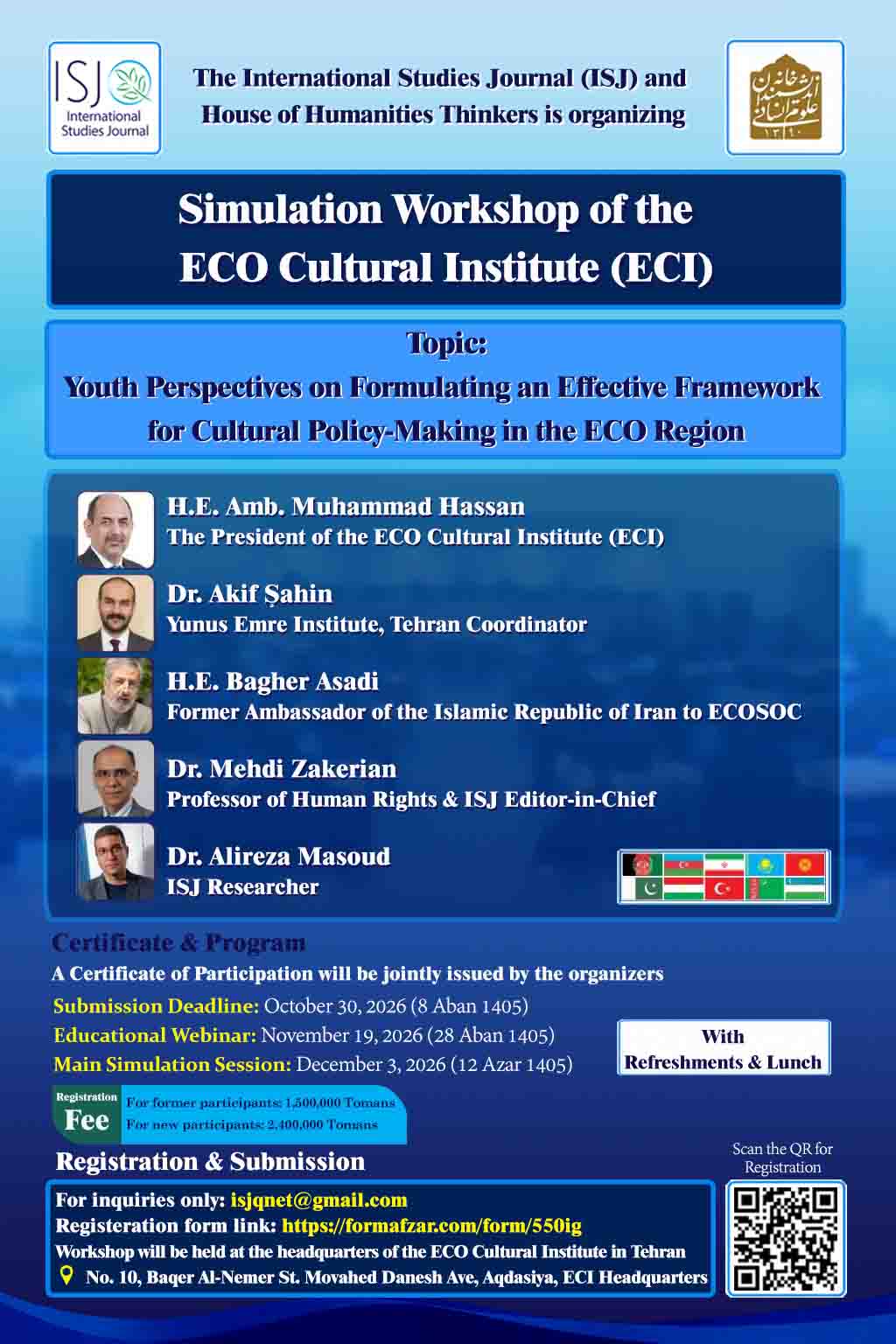
For registration to this program click  Here

The international studies journal (quarterly periodical) is a scientific journal which started its activities based on a regulation No. 25685/11 issued by ministry of research, science and technology on April 29, 2019.

For the kind attention of respected authors, Please consider this point that publishing articles in ISJ involves expenses.

For obtaining more information regarding the related costs, you can refer to the articles acceptance process in the journal information menu. For getting information regarding the arrangement of articles, you can refer to the guidance for authors. 
ISJ is a Gold Open Access Journal

For more information click  Here

For registration to this program click  Here

Indexing and Abstracting

Keywords Cloud

  • Human rights
  • Iran
  • international relations
  • Foreign Policy
  • Middle East
  • International Law
  • Security
  • China
  • US
  • Transitional Justice
  • Islam
  • terrorism
  • Saudi Arabia
  • globalization
  • Security Council
  • United States
  • \"
  • Power
  • Democracy
  • International Humanitarian Law
  • State
  • Russia
  • Politics
  • humanitarian law
  • Justice
  • Iran
  • Islamic Republic of Iran
  • Iraq
  • Women
  • Soft power
  • war
  • culture
  • universality
  • International Criminal Court
  • UN
  • Turkey
  • Geopolitics
  • ethics
  • EU
  • identity
  • Peace
  • interdisciplinary
  • Economic Development
  • Diplomacy
  • JCPOA
  • India
  • Israel
  • Human Rights Council
  • Palestine
  • Europe
  • Afghanistan
  • USA
  • Persian Gulf
  • Good Governance
  • Economy
  • Armed Conflict
  • Crimes against humanity
  • Responsibility to Protect
  • Occupied Territories
  • United States of America
  • United Nations
  • legitimacy
  • Development
  • Liberalism
  • America
  • international responsibility
  • Realism
  • strategy
  • Crisis
  • Securitization
  • integration
  • Responsibility
  • Sovereignty
  • pluralism
  • Egypt
  • constructivism
  • religion
  • National Security
  • Geneva Conventions
  • methodology
  • Syria
  • France
  • Balance of Power
  • Government
  • CEDAW
  • North Korea
  • cultural diplomacy
  • Political Economy
  • international relations
  • IHL
  • Donald Trump
  • International Court of Justice
  • sustainable development
  • War Crimes
  • International Community
  • Energy
  • European Union
  • philosophy
  • Foreign Investment
  • UN Reforms
  • Revolution
  • the United States
  • Terrorism
  • Civil Society
  • balance of threat
  • ISIS
  • Yemen
  • Human Security
  • Caspian Sea
  • United Arab Emirates
  • International System
  • Challenges
  • Regional organizations
  • regionalism
  • Human Rights Commission
  • Society
  • International Criminal Law
  • Regional Studies
  • Taliban
  • Obama
  • Nuclear Deal
  • Criminal law
  • Islamic Revolution
  • Gender
  • Artificial intelligence
  • Constitution
  • Trump
  • Ukraine
  • Discourse
  • Latin America
  • ICC
  • Democratization
  • critical theory
  • theory
  • Environment
  • secularism
  • COVID-19
  • political participation
  • freedom
  • Jihad
  • Tunisia
  • Economic
  • Africa
  • Arab Spring
  • Governance
  • Cyber Attack
  • public diplomacy
  • Environmental protection
  • Simulation
  • Economic Relations
  • Stability
  • International political economy
  • Hegemony
  • UN Charter
  • European Court of Human Rights
  • International Human Rights Law
  • Armed conflicts
  • International Security
  • use of force
  • U.S
  • right to health
  • humanitarian intervention
  • Islamism
  • Humanity
  • Geography
  • Libya
  • Immigration
  • Human Rights Report
  • Persian Gulf
  • international politics
  • Koran
  • colonialism
  • technology
  • Rule of law
  • Israeli regime
  • cooperation
  • International Environmental Law
  • energy Security
  • Torture
  • Human dignity
  • international order
  • European Union (EU)
  • threat
  • Treaties
  • Regional Order
  • Britain
  • Germany
  • Ahmadinejad
  • Jurisdiction
  • political science
  • Copenhagen School
  • communication
  • Al-Qaeda
  • moderation
  • Sanction
  • Genocide
  • Geoeconomics
  • Ideology
  • Dialogue
  • hard power